I’ve just been elected President of the Swiss Political Science Association. This is a great honor and I am looking forward to contributing to the advancement of the interests of the Swiss political science community.

Department of Political Science / School of Economics and Political Science, University of St.Gallen
I’ve just been elected President of the Swiss Political Science Association. This is a great honor and I am looking forward to contributing to the advancement of the interests of the Swiss political science community.
There is probably no book more influential in comparative welfare state research than Gøsta Esping-Andersen’s The Three Worlds of Welfare Capitalism. To celebrate the 25th birthday of this seminal piece of academic scholarship, I have co-edited (together with Jon Kvist, Paul Marx and Klaus Petersen) a special issue in the most important social policy review, the Journal of European Social Policy, which will be published as the first issue in 2015. The following articles will be printed in the special issue:
The special issue will also play a prominent role in the 2015 ESPAnet conference, which will be held at the University of Southern Denmark.
In November 27-28, 2014, I will welcome some of the most well known researchers on international tax competition and financial secrecy for a workshop at the University of St. Gallen.
Recent years have witnessed tremendous changes in the field of international tax competition and financial secrecy. For instance, the OECD is close to a breakthrough with its project to extend the model agreement to include the automatic exchange of information in tax matters, while countries such as Luxembourg and Switzerland have committed to accept this new model agreement if it is made a global standard. In parallel, the OECD has been pushing forward the international debate on corporate taxation and transfer pricing, while the EU has begun to revise its Tax Savings Directive to close loopholes that reduce tax income based on savings-generated income and to extend automatic exchange of information to the remaining holdouts.
After many commentators had been rather pessimistic about the prospects of international cooperation in the field of taxation, this sudden wave of regulatory activity raises a series of important questions concerning the politics of international tax competition and financial secrecy. Such questions include: What made countries such as Liechtenstein and Austria give up their decades-long resistance against calls for more transparency? What role did multilateral action by the OECD or the G20 play? How did these actors overcome the collective action problems that have hampered previous attempts to regulate international tax competition? How important has blacklisting been in this process? To what extent will the automatic exchange of information be extended to developing countries? Are we witnessing the end of tax havens or is the caravan simply moving on to new offshore financial centers? What role did leadership by the USA play? Will the USA continue to resist calls for more transparency in case of incorporation services? And are recent regulatory activities really changing international tax competition or are we simply witnessing a sophisticated exercise in window-dressing?
This workshop will bring together leading international experts on the politics of tax competition and financial secrecy to discuss these highly important questions and to expand our understanding of this crucial field of global economic governance.
We have won the Best Paper Award by the CES Research Network on Political Economy and Welfare for the best conference paper at the 2014 CES annual conference. The article “Labour Market Disadvantage, Political Orientations and Voting: How Adverse Labour Market Experiences Translate into Electoral Behaviour” (together with Paul Marx and Dominik Schraff) will be published in 2015 in the prestigious Socio-Economic Review.
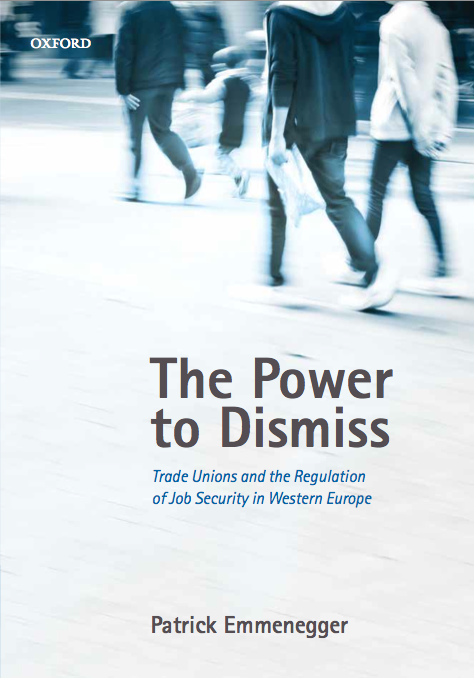
The publication date for “The Power to Dismiss: Trade Unions and the Regulation of Job Security in Western Europe” is scheduled for 15th Oct 2014 (the book will be published two months later in North America). Here is already the book cover:
My paper, entitled “Religion and the Gender Vote Gap: Women’s Changed Political Preferences from the 1970s to 2010” and co-authored with Philip Manow, has now appeared in print. Here is the abstract:
For many years women tended to vote more conservative than men, but since the 1980s this gap has shifted direction: women in many countries are more likely than men to support left parties. The literature largely agrees on a set of political- economic factors explaining the change in women’s political orientation. In this article we demonstrate that these conventional factors fall short in explaining the gender vote gap. We highlight the importance of a religious cleavage in the party system across Western European countries, restricting the free flow of religious voters between left and right parties. Given that surveys show us a constantly higher degree of religiosity among women and a persistent impact of religion on vote choice, religion explains a substantial part of the temporal as well as cross-country variation in the transition from the more conservative to the more progressive voting behavior of women.
Emmenegger, Patrick and Philip Manow (2014): Religion and the Gender Vote Gap: Women’s Changed Political Preferences from the 1970s to 2010. Politics and Society 42(2): 166-193.
This fall term I offer the following four courses:
Political Science Fundamentals of International Relations (MA lecture)
Social Science Methodology: Concepts and Measurement (MA lecture)
Comparative Welfare State Politics: Development, Challenges and Reform (MA seminar)
Methods Seminar (PhD seminar)
This spring term I offer the following three courses:
Social Science Methodology: Research Design (MA lecture)
Structural Challenges in International Politics: The Case of Financial Intransparency (MA seminar, together with the former German ambassador Peter Gottwald)
Dissertation Seminar (PhD seminar)
New publication forthcoming. My first article on the politics of banking secrecy.
Emmenegger, Patrick (2014): The Politics of Financial Intransparency: The Case of Swiss Banking Secrecy. Swiss Political Science Review 20(1). Forthcoming.
Hopefully many more to come!

 Patrick Emmenegger